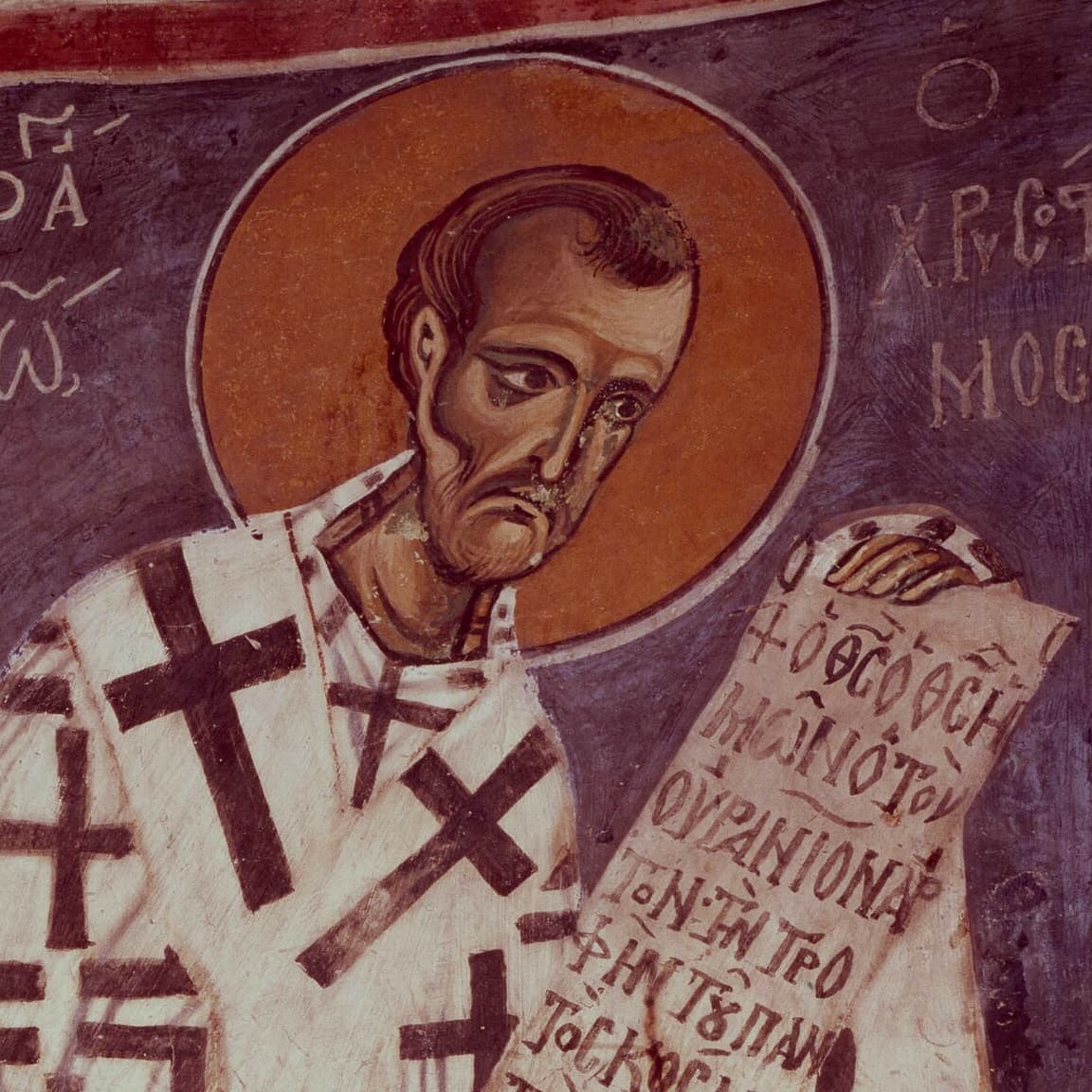
St. John Chrysostom
34 works on Theoria18 with audio
Works available to read
- Against the Jewsc. 386–387 ADEight homilies preached at Antioch in 386–387 AD against Christians who were drawn to Jewish festivals and fasts. Chrysostom argues that the Mosaic law has been fulfilled in Christ and that participation in synagogue rites is incompatible with Christian baptism, drawing repeatedly on Deuteronomy, the Prophets, and the destruction of the Temple as warrants for his pastoral concern.
- An Exhortation to Theodore After His Fallc. 369 ADTwo letters urging Theodore, who had abandoned monastic life for a worldly liaison, to repent and return — a powerful appeal to divine mercy and the possibility of restoration.
- Commentary on GalatiansChrysostom's continuous commentary on the Epistle to the Galatians, arranged by chapter rather than as discrete homilies, bringing Antiochene exegesis to bear on Paul's defense of the gospel of grace.
- Correspondence with the Bishop of Romec. 404–407 ADLetters exchanged between Chrysostom and Pope Innocent I during Chrysostom's unjust exile, documenting the early church's appeal to Rome in cases of episcopal injustice.
- Homilies on ColossiansChrysostom's homilies expounding Paul's Epistle to the Colossians, centered on the cosmic preeminence of Christ and the ethical renewal of the new humanity in him.
- Homilies on EphesiansA series of homilies on Ephesians treating the mystery of God's eternal plan, the unity of Jew and Gentile in Christ, the Church as his Body, and the moral shape of Christian life.
- Homilies on First Corinthiansc. 391 ADForty-four homilies delivered at Antioch covering 1 Corinthians verse by verse, addressing the Corinthian quarrels, sexual ethics, the eucharist, spiritual gifts, and the resurrection.
- Homilies on First ThessaloniansChrysostom's homilies on 1 Thessalonians, unfolding Paul's apostolic memory of the Thessalonian church and his teaching on holiness, fraternal love, and the coming of the Lord.
- Homilies on First TimothyHomilies on 1 Timothy treating the ordering of prayer, worship, ministry, and widows in the pastoral churches, and Paul's charge to Timothy to guard the deposit of faith.
- Homilies on PhilemonChrysostom's short sequence of homilies on the Letter to Philemon, reading Paul's appeal for the runaway slave Onesimus as a lesson in Christian mercy and mutual obligation.
- Homilies on PhilippiansHomilies on Philippians, drawing out the hymn of Christ's self-emptying in chapter 2 and the pastoral themes of joy, partnership in the gospel, and contentment in Christ.
- Homilies on Second Corinthiansc. 392 ADChrysostom's homilies on 2 Corinthians, preached at Antioch around 392, exploring Paul's defense of his apostolic ministry, the ministry of the new covenant, and the collection for the saints.
- Homilies on Second ThessaloniansChrysostom's homilies on 2 Thessalonians, addressing the apostle's warnings about the coming of the lawless one and the pastoral need for settled, orderly Christian labor.
- Homilies on Second TimothyHomilies on 2 Timothy, Paul's final letter from prison, meditating on perseverance under suffering, the usefulness of Scripture, and the last charge of an apostle to his disciple.
- Homilies on St. Ignatius and St. Babylasc. 386–397 ADPanegyric homilies celebrating the martyrdom and legacy of St. Ignatius of Antioch and St. Babylas, delivered to inspire the faithful through the witness of the martyrs.
- Homilies on the Acts of the Apostlesc. 400 ADChrysostom's verse-by-verse exposition of the book of Acts, combining exegesis with moral and practical instruction for the Christian life.
- Homilies on the Epistle to the HebrewsThirty-four homilies on the Epistle to the Hebrews, taken down by Constantine the presbyter and published after Chrysostom's death — a sustained exposition of Christ as the great high priest of the new covenant.
- Homilies on the Epistle to the Romansc. 391 ADChrysostom's celebrated commentary on Paul's Epistle to the Romans, renowned for its moral exhortation and pastoral application.
- Homilies on the Gospel of Saint MatthewNinety homilies on the Gospel of Matthew delivered at Antioch, widely regarded as Chrysostom's exegetical masterpiece, combining careful verse-by-verse commentary with searching moral exhortation.
- Homilies on the Gospel of St. JohnChrysostom's homilies on the Gospel of John, reading the Fourth Gospel verse by verse against the Arians and Anomœans and unfolding its theology of the incarnate Word and the life he gives.
- Homilies on the Statuesc. 387 ADTwenty-one homilies preached during the crisis after Antioch's citizens toppled imperial statues in a tax riot, as the city awaited possible destruction — a masterwork of pastoral courage and eloquence.
- Homilies on TitusChrysostom's homilies on the Epistle to Titus, treating the ordering of the church in Crete, the qualifications of presbyter-bishops, and the pastoral shape of grace-formed life.
- Homily Against Publishing the Errors of the Brethrenc. 386–397 ADA homily against exposing others' faults and uttering curses, urging charity and prayer even toward those who wrong us.
- Homily Concerning Lowliness of Mindc. 386–407 ADA homily on humility as the foundation of all virtue, drawing on the example of Christ and the apostles.
- Homily on 'Father, If It Be Possible, Let This Cup Pass'c. 386–407 ADAn exegetical homily on Christ's prayer in Gethsemane, refuting Marcionite and Manichean misinterpretations of Christ's human nature.
- Homily on the Paralytic Let Down Through the Roofc. 386–407 ADA homily on the healing of the paralytic, exploring the equality of the Father and Son and the relationship between sin and suffering.
- Homily to Those Who Had Not Attended the Assemblyc. 386–397 ADA homily rebuking those absent from worship, expounding on Romans 12:20 and the Christian duty to feed even one's enemies rather than harbor resentment.
- Instructions to Catechumensc. 388 ADTwo instructions delivered to those preparing for baptism, explaining the meaning of the sacrament and the moral transformation it requires.
- Letter to a Young Widowc. 380 ADA pastoral letter consoling a young widow and encouraging her to remain in her widowed state rather than remarry, presenting widowhood as a high spiritual calling.
- Letters to Olympiasc. 404–407 ADSeventeen letters written from exile to the deaconess Olympias, his closest spiritual friend — intimate pastoral correspondence revealing his character under suffering.
- No One Can Harm the Man Who Does Not Injure Himselfc. 406–407 ADWritten from exile, a treatise arguing that external persecution cannot truly harm the Christian whose soul is fortified by virtue — only self-inflicted sin can wound.
- On the Priesthoodc. 386 ADChrysostom's celebrated dialogue on the dignity, responsibilities, and dangers of the priestly office, written to defend his own flight from ordination.
- Three Homilies Concerning the Power of Demonsc. 386–397 ADThree homilies teaching that demons have no power over those who live virtuously, and that sin alone makes one vulnerable to demonic influence.
- Two Homilies on Eutropiusc. 399 ADTwo dramatic homilies delivered when the once-powerful minister Eutropius sought sanctuary in the church he had tried to strip of its right of asylum — a powerful meditation on the vanity of worldly power.
Browse every Church Father in the authors index or the full Theoria library.