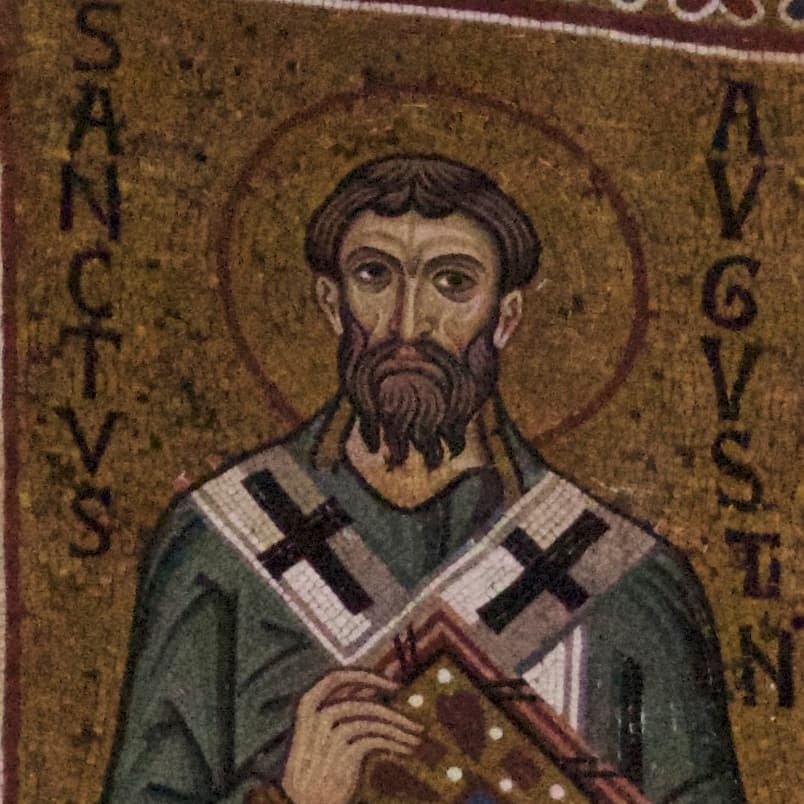
St. Augustine of Hippo
Post-Nicene32 works on Theoria16 with audio
Works available to read
- Acts or Disputation Against Fortunatus the ManichæanThe verbatim acts of Augustine's public debate with Fortunatus the Manichaean at Hippo in September 392, centered on the origin of evil and closing with Fortunatus's retreat from the argument.
- Against the Epistle of Manichæus, Called FundamentalContra Epistulam Manichaei quam vocant Fundamenti, a refutation of the foundational letter of Manichaean catechesis, attacking its dualistic cosmology and defending the one good Creator.
- Against Two Letters of the PelagiansFour books to Pope Boniface replying to two Pelagian letters — one by Julian of Eclanum and another in the name of eighteen bishops — defending Catholic doctrine on original sin, baptism, and grace.
- Concerning Man's Perfection in RighteousnessA short treatise responding to the "Definitions" attributed to Celestius, disputing the Pelagian claim that sinless righteousness is attainable by the unaided powers of fallen human nature.
- Concerning the Nature of Good, Against the ManichæansDe Natura Boni, a concise metaphysical refutation of Manichaean dualism, teaching that whatever exists is good insofar as it exists and that evil is the privation or corruption of good.
- Expositions on the Book of PsalmsAugustine's vast series of sermons and notes on the entire Psalter, preached over many years at Hippo — a sustained pastoral reading of the Psalms as the voice of Christ and His whole Body, the Church.
- Homilies on the First Epistle of JohnTen homilies on the First Epistle of John, preached during Easter week and beyond, unfolding Christian love for God and neighbour as the heart of the apostolic gospel.
- Letters of St. Augustinec. 386–430 ADA substantial selection from Augustine's correspondence — pastoral, polemical, and personal — addressed to emperors, bishops, monks, and ordinary Christians over the course of his long episcopate at Hippo.
- Moral TreatisesAugustine's major moral treatises — including On Continence, On the Good of Marriage, On Holy Virginity, On the Good of Widowhood, On Lying, and On Patience — gathered in NPNF Vol. III.
- On Christian Doctrine397–426 ADAugustine's guide to interpreting Scripture and communicating Christian truth.
- On Grace and Free WillDe Gratia et Libero Arbitrio, written to the monks of Hadrumetum around 426–427, defending both the reality of free will and the necessity of divine grace for any meritorious human act.
- On Marriage and ConcupiscenceTwo books to Count Valerius on marriage and concupiscence (419–420), distinguishing the good of the marriage bond from the disordered concupiscence that entered the world through original sin.
- On Nature and GraceDe Natura et Gratia, Augustine's reply to Pelagius's On Nature, showing that fallen nature cannot achieve righteousness without the healing and liberating grace of Christ.
- On Rebuke and GraceDe Correptione et Gratia, addressed to the monks of Hadrumetum, arguing that rebuke of sinners is compatible with the doctrine of grace and that perseverance itself is a gift of God.
- On the Grace of Christ, and on Original SinTwo books addressed to Albina, Pinianus, and Melania (c. 418) defending the grace of Christ against Pelagius and the doctrine of original sin against Celestius.
- On the Merits and Forgiveness of Sins, and on the Baptism of InfantsDe Peccatorum Meritis et Remissione et de Baptismo Parvulorum, three books to Marcellinus on original sin, the necessity of infant baptism, and the scope of Christ's redemptive work.
- On the Morals of the Catholic ChurchDe Moribus Ecclesiae Catholicae, the first half of a paired work comparing Catholic and Manichaean life, setting out the Church's moral vision as love for God ordering the four cardinal virtues.
- On the Morals of the ManichæansDe Moribus Manichaeorum, the companion treatise, exposing the incoherence of Manichaean asceticism and cosmology and showing the inconsistency between their doctrine and their manner of life.
- On the Predestination of the SaintsAddressed to Prosper and Hilary in 428–429, this treatise defends the gratuity of grace against the "Semi-Pelagian" view that the beginning of faith comes from ourselves.
- On the Proceedings of PelagiusDe Gestis Pelagii, Augustine's careful review (c. 417) of the acts of the synod of Diospolis (Lydda) of 415, showing that Pelagius was acquitted there only by disavowing the doctrines actually at issue.
- On the Soul and Its OriginFour books occasioned by the writings of Vincentius Victor on the soul, defending Augustine's reserve about the mode of the soul's origin while refuting Victor's Pelagian and materialist errors.
- On the Spirit and the LetterDe Spiritu et Littera, addressed to Marcellinus in 412, arguing from 2 Corinthians 3 that the law without the life-giving Spirit condemns, and that true righteousness is the work of grace.
- On the TrinityAugustine's fifteen-book De Trinitate, a major exposition of trinitarian doctrine and the image of God in the human mind.
- On Two Souls, Against the ManichæansDe Duabus Animabus, an early anti-Manichaean treatise refuting the doctrine that each human being has two souls — one good, one evil — by showing that evil arises from the free will of a single soul.
- Our Lord's Sermon on the MountTwo books of close exegesis on Matthew 5–7, including the Beatitudes and the Lord's Prayer, and setting out Augustine's reading of the Christian life as the soul's Spirit-led ascent through the gifts of the Holy Spirit.
- Reply to Faustus the ManichæanContra Faustum Manichaeum, thirty-three books refuting the most prominent Manichaean teacher of Augustine's day, defending the unity of the two Testaments and the goodness of the Old Testament saints.
- Sermons on Selected Lessons of the New TestamentA large collection of Augustine's sermons on selected passages from the Gospels and Epistles, preached to his congregation at Hippo and showing his characteristic blend of plain exposition and devotional warmth.
- SoliloquiesAugustine's earliest Christian work, written at Cassiciacum shortly after his baptism — a two-book interior dialogue between the soul and Reason on the knowledge of God and the immortality of the soul.
- The City of God413–426 ADAugustine's monumental work on the relationship between the earthly and heavenly cities, written after the sack of Rome.
- The Confessionsc. 397–400 ADAugustine's spiritual autobiography, one of the most influential works in Christian literature, tracing his journey from sin to salvation.
- The Harmony of the GospelsDe Consensu Evangelistarum, four books demonstrating the agreement of the four evangelists and refuting pagan and Manichaean claims that the Gospels contradict one another or misrepresent Jesus.
- Tractates on the Gospel of JohnThe 124 Tractates on the Gospel of John, Augustine's long homiletic commentary on the Fourth Gospel preached at Hippo, treating the Word made flesh as the center of Christian life and the Church's life as love.
Browse every Church Father in the authors index or the full Theoria library.